

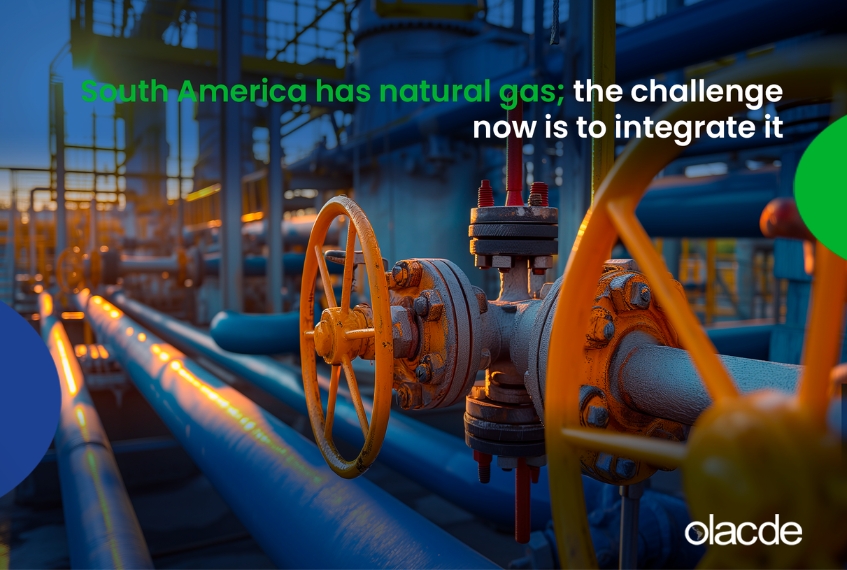
South America has reached a pivotal moment in its energy transition. After years of concern over natural gas availability, the regional landscape has changed significantly. Today, the central challenge is to build an integrated regional gas market that maximizes existing resources, strengthens energy security, and transforms energy into a driver of competitiveness and sustainable development across Latin America and the Caribbean.
This was the key message delivered by Guido Maiulini, Head of Strategic Advisory at the Latin American and Caribbean Energy Organization (OLACDE), during the webinar Towards a Regional Natural Gas Market, organized by the Electronic Gas Market (MEGSA). During his presentation, Maiulini outlined the main findings of OLACDE’s regional gas integration study, developed in partnership with CAF – Development Bank of Latin America and the Caribbean, which redefines the opportunities for energy cooperation among the MERCOSUR countries and Chile.
“The real challenge is no longer the availability of natural gas—it is building a regional market,” Maiulini stated, summarizing the new energy reality facing South America.
According to the study, the region is now in an unprecedented position to advance deeper energy integration. Argentina’s Vaca Muerta formation alone could meet regional demand well beyond 2050, while Brazil’s natural gas production is projected to triple by 2040, driven by continued development of its offshore Pre-salt reserves. At the same time, Bolivia’s gradual production decline is reshaping regional supply flows, creating an opportunity to redesign the regional gas market around a new framework of cooperation.
A Regional Economic Opportunity
OLACDE’s projections indicate that greater integration could significantly expand regional energy trade. A fully integrated South American natural gas market could facilitate between 60 and 70 million cubic meters of gas per day, generate USD 4–5 billion annually in regional energy trade, and replace approximately USD 2.4 billion per year in imported fuels, reducing external dependence while strengthening regional energy resilience.
For OLACDE, these findings demonstrate that energy integration is no longer merely a technical objective—it has become a strategic policy tool to stimulate economic growth, enhance industrial competitiveness, and improve long-term energy security.
Integration for a More Resilient Future
OLACDE stresses that stronger regional energy integration is essential to reducing countries’ vulnerability to global crises, supply disruptions, and volatility in international energy markets.
As part of this effort, the Organization is working alongside MERCOSUR Working Subgroup No. 9 to advance a regulatory convergence agenda aimed at harmonizing technical standards, contractual frameworks, tariff structures, crisis management mechanisms, and energy information exchange among member countries.
Concluding his remarks, Maiulini emphasized that the value of energy integration extends well beyond natural gas trade.
“Energy has the potential to become one of the fundamental pillars for addressing Latin America’s long-standing development challenges,” he said, noting that a more integrated regional market will improve productivity, attract new investment, expand economic opportunities, and ultimately enhance the quality of life for millions of people across Latin America and the Caribbean.
Through this initiative, OLACDE reaffirms its commitment to advancing regional energy integration based on cooperation, energy security, and more efficient markets capable of transforming South America’s abundant energy resources into drivers of sustainable development and shared prosperity.