

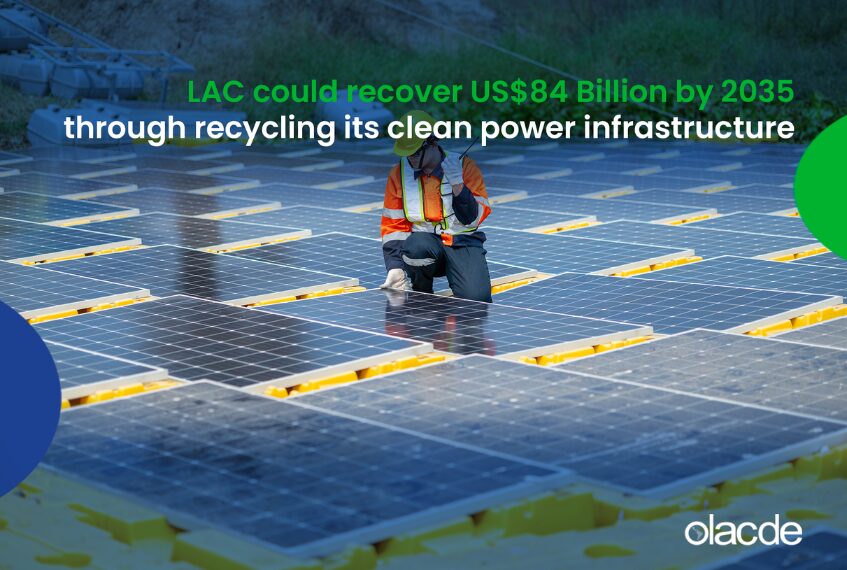
Latin America and the Caribbean’s continued shift toward renewable energy—which accounted for 67.4% of the region’s electricity generation in 2025—is bringing a new challenge to the forefront: managing waste from its own clean energy infrastructure. Although the expansion of solar and wind technologies began only about a decade ago and most equipment currently in operation has not yet reached the end of its useful life, premature failures and technological upgrades are accelerating the disposal of solar panels, wind turbines, and batteries.
This scenario has prompted several countries to develop plans, programs, and regulations for recycling recoverable components. The objective is to mitigate environmental impacts throughout the entire life cycle of these technologies, preventing heavy metals, plastics, and corrosive or toxic substances from contaminating soil, air, and water.
A Technical Note published by the Latin American and Caribbean Energy Organization (OLACDE) explains that this growing waste stream represents a circular economy opportunity, with potentially recoverable economic value reaching US$209 billion by 2050 through recycling, reuse, and material recovery strategies. This perspective broadens the sectoral discussion by highlighting the need to assess the economic potential of secondary resources rather than focusing solely on the physical volume of waste.
The region currently has approximately 150 million solar panels and 16,000 wind turbines in operation. Combined with the rapid growth of battery storage, solar, and wind energy, these figures provide an indication of the scale of materials that could accumulate by mid-century:
- 81 million tonnes of total materials will be embedded in energy transition technologies.
- 36 million tonnes will be steel, equivalent to 63% of the region’s current annual steel production.
- 4 million tonnes will be copper, a volume equivalent to nearly 40% of the region’s annual production.
- 10 million tonnes will be aluminum, almost three times the current annual production of Latin America and the Caribbean.
The study indicates that recovering these components could reduce demand for new extractive activities, lower mining-related emissions, and strengthen security of supply for resources considered critical worldwide.
Artificial Intelligence in the Circular Economy
The Technical Note identifies artificial intelligence as a key enabler in the management of these assets. Digital tools and predictive systems enable continuous equipment monitoring, facilitating more efficient maintenance scheduling, extending equipment lifespans, and automating the classification of components for refurbishment or recycling.
In the specific case of lithium-ion batteries used in electric mobility, algorithms can analyze operational histories to determine when a battery module can be repurposed for a second life in stationary energy storage applications. This approach extends the device’s overall life cycle and delays the need for final end-of-life management.
An Industrial Opportunity for the Region
OLACDE argues that the circular economy presents an opportunity for industrial development across the region. Recovering critical materials could reduce dependence on virgin raw materials, lower strategic imports, create new regional value chains, generate specialized employment, and strengthen supply security for the energy sector of the future.
However, the document warns that developing this industry will require stronger and more specific regulatory frameworks, extended producer responsibility schemes, traceability systems, and reverse logistics, as these capabilities remain at an early stage in most countries across the region.
The sustainability of the energy sector does not end with the installation of wind farms, solar photovoltaic facilities, or battery systems. It will also depend on the region’s ability to efficiently transform technological waste into new productive resources.
Read the full Technical Note: