

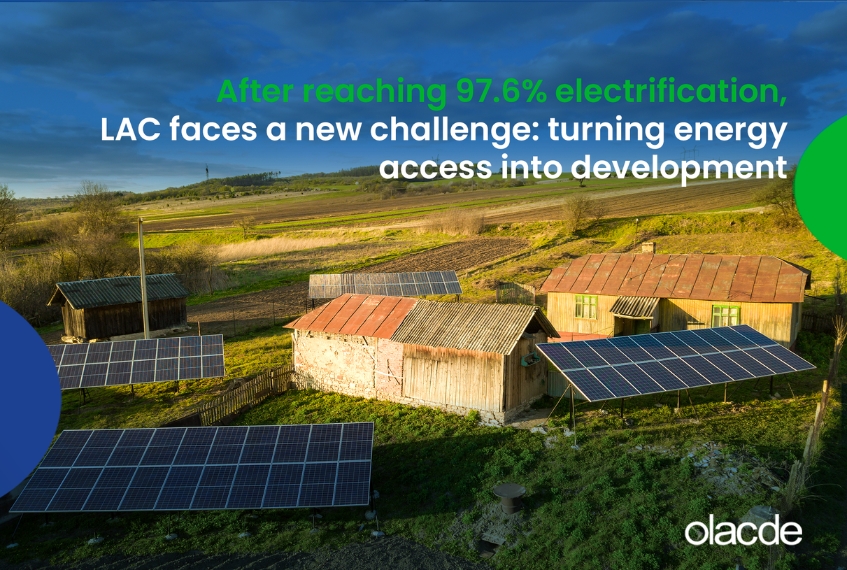
Providing electricity to a community is no longer enough. The new challenge facing Latin America and the Caribbean is to transform energy access into employment, productivity and local economic development.
With this objective, the Latin American and Caribbean Energy Organization (OLACDE) participated in the Knowledge Exchange on Productive Uses of Energy in Latin America, an event organized by the International Renewable Energy Agency (IRENA) with the support of Practical Action and the Global Energy Alliance for People and Planet (GEA).
During the event, Gloria Alvarenga, OLACDE’s Director of Integration, Energy Access and Energy Security, outlined how stronger regional cooperation can transform rural electrification into a driver of productive development, social inclusion and economic resilience.
The forum brought together government representatives, international organizations and energy experts from Brazil, Bolivia, Colombia, Ecuador and Peru to discuss public policies, financing models, community governance frameworks and technological solutions aimed at promoting the productive use of renewable energy in rural and remote communities.
Beyond electrification
The discussion was grounded in a clear regional reality. Although Latin America and the Caribbean has achieved an electricity access rate of more than 97.6%, millions of people living in the Amazon, the Andes and other rural areas still lack reliable and sufficient electricity services capable of supporting sustainable economic activities.
Participants agreed that the concept of Productive Uses of Energy (PUE) represents the next stage of the energy transition: using electricity not only for basic household consumption, but also to generate income, add value to agricultural production, strengthen rural small businesses and stimulate local economies.
Gloria Alvarenga noted that between 16 and 17 million people across the region still lack access to electricity, with the greatest deficits concentrated in rural and Indigenous communities. Since 2015, progress toward universal electrification has slowed significantly. In remote regions such as the Amazon, connecting a single household through conventional grid infrastructure can cost up to USD 20,000, underscoring the need for innovative technological solutions.
She also highlighted that the region requires annual investments of USD 6–8 billion through 2030 to modernize electricity transmission infrastructure. However, only USD 3.3 billion was invested in 2022, revealing a substantial financing gap.
For OLACDE, the knowledge exchange reinforces a strategic regional priority: ensuring that the energy transition goes beyond expanding electricity access to create new opportunities for sustainable economic development, reduce territorial inequalities and strengthen the resilience of rural communities to social and climate-related challenges.
The meeting will conclude with a set of policy recommendations designed to strengthen regional cooperation and inform future strategies for advancing the productive use of energy across Latin America and the Caribbean.