

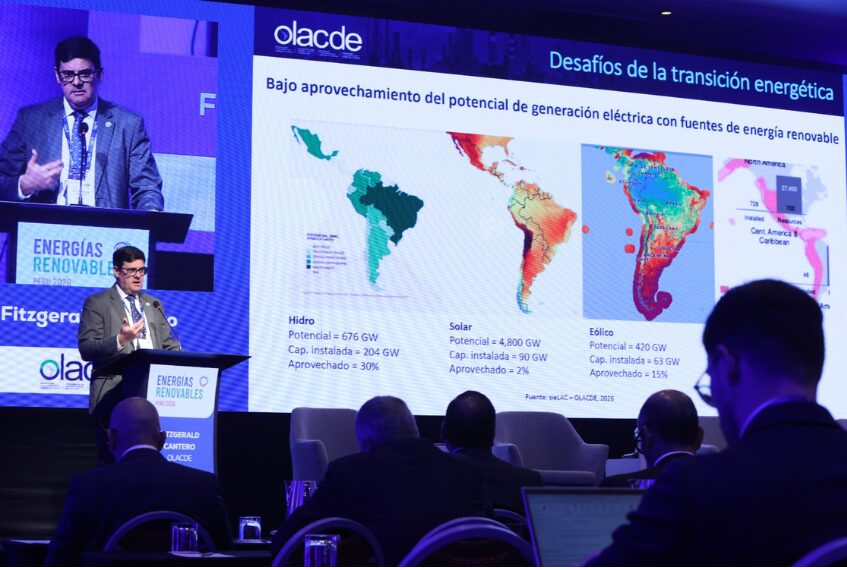
The Latin American and Caribbean Energy Organization (OLACDE) participated in the XIII Renewable Energy Conference Peru 2026, a regional forum where the progress, challenges, and opportunities of the energy transition in Latin America and the Caribbean were discussed. Representing the Organization, Fitzgerald Cantero Piali, Director of Studies, Projects and Information, delivered a presentation titled “The Role of Renewable Energy in the Energy Transition: Progress and Challenges in Latin America.”
During his presentation, he highlighted the sustained growth of renewable energy capacity in the region over the past decade, driven mainly by the expansion of hydropower, solar, and wind technologies. He noted that although nearly 70% of the region’s electricity generation comes from renewable sources, Latin America and the Caribbean still have significant untapped potential in hydropower, solar, geothermal, and wind energy, positioning the region as a strategic player in the global energy transition.
However, he emphasized that one of the main current challenges is the need to expand electricity transmission infrastructure and deepen regional energy integration in order to efficiently utilize the available clean energy. In this context, he noted that energy curtailment in the region represented losses of approximately USD 8.413 billion in 2025, highlighting the urgency of strengthening energy planning, infrastructure, and regional coordination.
He also highlighted the rapid expansion of electromobility in Latin America and the Caribbean, which grew from 17,541 electric vehicles in 2020 to more than 674,915 in 2025, reflecting a structural shift in the region’s energy consumption. In this regard, he stressed the importance of accelerating electrification in sectors such as transport and industry, as well as strengthening public policies, modern regulatory frameworks, and sustained investments that will enable the scaling up of new industries such as green hydrogen.
Finally, he emphasized that the energy transition in Latin America represents not only a technological and environmental challenge, but also an opportunity for economic development, regional integration, and the reduction of social gaps, as it can expand access to energy, create new value chains, and strengthen the region’s energy security.