

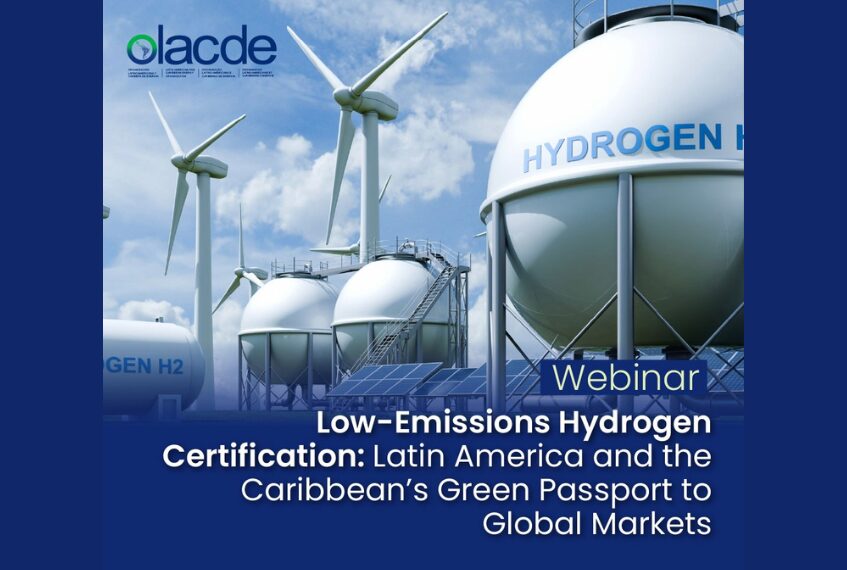
The Latin American and Caribbean Energy Organization (OLACDE) held the webinar “Low-Emissions Hydrogen Certification: The Green Passport of Latin America and the Caribbean to Global Markets”, where the main results of the project aimed at strengthening regional capacities to comply with international certification standards for low- or zero-emissions hydrogen and its derivatives for export purposes were presented.
The project is implemented under the Chile–European Union Joint Triangular Cooperation Fund by the Latin American and Caribbean Energy Organization (OLACDE), with the support of the European Union and the Chilean Agency for International Development Cooperation (AGCID).
During the webinar, regional recommendations to advance hydrogen certification were presented, along with a digital simulation platform designed to verify compliance with international standards required for the export of low-emissions hydrogen to global markets. This platform represents a key tool to support countries in the region in developing this emerging industry.
The Executive Director of AGCID, Enrique O’Farrill-Julien, highlighted that this initiative demonstrates how triangular cooperation can translate into concrete and impactful solutions. He noted that the joint work between OLACDE, the European Union and AGCID, together with the participation of countries in the region and technical partners, has enabled progress in capacity building, the development of national roadmaps, and the construction of a shared regional vision on hydrogen certification.
In the same vein, OLACDE Executive Secretary Andrés Rebolledo emphasized that low-emissions hydrogen certification is a strategic element for the international positioning of Latin America and the Caribbean. He noted that, in the current international context, advancing this industry is more relevant than ever for the region, both from an energy and economic perspective.
As part of the project, gaps were identified and action proposals were developed to ensure that hydrogen produced in the region meets international certification standards. Roadmaps for the pilot countries — Argentina, Chile, Colombia, and Panama — were also presented, along with regional recommendations to advance hydrogen certification.
Finally, the document summarizing the main results of the project, titled “Low-Emissions Hydrogen Certification: The Green Passport of Latin America and the Caribbean to Global Markets”, was officially launched. The publication compiles recommendations, tools, and guidelines to advance certification and facilitate the integration of low-emissions hydrogen from the region into international markets.