

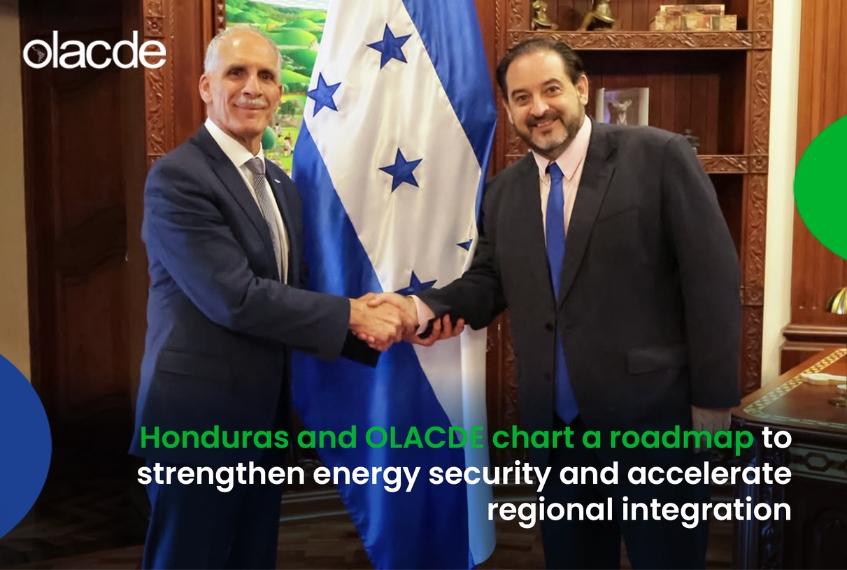
Honduras and the Latin American and Caribbean Energy Organization (OLACDE) have strengthened their strategic cooperation through a roadmap aimed at advancing energy planning, promoting regional integration, and reinforcing the country’s energy security in an increasingly challenging global environment.
During an official meeting, President of Honduras Nasry Asfura and OLACDE Executive Secretary Andrés Rebolledo agreed on a joint agenda focused on national energy planning, regional energy market integration, the electrification of the economy, and the development of human capital through OLACDE’s regional training and capacity-building programs across Latin America and the Caribbean.
As part of this agenda, OLACDE will provide technical assistance for the development of Honduras’ first National Energy Policy, a milestone that will provide the country, for the first time, with a long-term strategic framework to guide the development of its energy sector. Following the official exchange of diplomatic notes, both parties launched the policy development process and initiated efforts to secure support for its implementation. The initiative is backed by the European Union through GET.transform.
The policy will be developed through a participatory process involving nationwide assessments and consultations, structured around 16 thematic pillars covering hydrocarbons, natural gas, renewable energy, electric mobility, governance, and social responsibility. Its objective is to establish a comprehensive roadmap that aligns the country’s energy sector around a shared vision, positioning it as a driver of sustainable, competitive, and inclusive development.
The agreement comes at a time of growing uncertainty in the global energy landscape, characterized by market volatility, rising electricity demand, increasing competition for critical minerals and emerging technologies, and the need to build more resilient energy systems. Against this backdrop, Honduras and OLACDE reaffirmed that long-term energy planning and regional cooperation are essential to strengthening energy security, attracting investment, and enhancing the country’s competitiveness.
Energy Integration: The Region’s Greatest Challenge
Regional energy integration was one of the central themes of the meeting. Honduras and OLACDE agreed that strengthening interconnection among countries will enable more efficient use of available energy resources, complement electricity generation capacities, improve the reliability of power systems, and expand access to secure, competitive, and sustainable energy for all citizens across Latin America and the Caribbean.
Electrification is a key instrument for achieving this objective. Latin America and the Caribbean hold a unique strategic advantage: nearly 70% of the region’s electricity generation comes from renewable sources, making it home to one of the cleanest power matrices in the world. Leveraging this potential through greater regional integration will optimize existing infrastructure, facilitate the incorporation of additional renewable energy sources, enhance the efficiency of electricity systems, and ensure a more reliable and affordable energy supply across the region.
Building the Workforce to Lead the Energy Transition
As part of his official visit, OLACDE Executive Secretary Andrés Rebolledo met with authorities from the National Autonomous University of Honduras (UNAH) to strengthen academic cooperation and expand regional education and training programs designed to prepare the skilled workforce required for the energy transition. During the visit, the delegation also toured the university’s Renewable Energy Laboratory, where they learned about its technical and research capabilities supporting the education of future energy professionals.
This activity was carried out within the framework of the ETRELA Project, funded by the International Climate Initiative (IKI) of the German Federal Ministry for the Environment, Nature Conservation, Nuclear Safety and Consumer Protection (BMUKN) and implemented by a consortium comprising OLACDE, the Renewables Academy (RENAC), Global Factor, and the universities participating in the project.
Through its CAPEVLAC initiative, OLACDE has become one of the leading centers for specialized energy training in Latin America and the Caribbean. Every year, thousands of professionals from governments, companies, universities, and public institutions strengthen their expertise through courses, diploma programs, master’s degrees, and executive education programs in areas including energy planning, regional integration, artificial intelligence applied to the energy sector, energy transition, gender and energy, energy efficiency, hydrogen, energy storage, regulation, geopolitics, and electric mobility.
A Shared Vision for the Region’s Energy Future
The official visit reaffirmed the shared commitment of Honduras and OLACDE to advancing an energy model based on cooperation, regional integration, and long-term planning. With abundant renewable resources, one of the cleanest electricity matrices in the world, and growing potential to develop new value chains in sectors such as hydrogen, biofuels, and energy storage, Latin America and the Caribbean are well positioned to become one of the world’s leading energy hubs of the 21st century.
The meeting between President Nasry Asfura and Executive Secretary Andrés Rebolledo reinforces Honduras’ commitment to regional energy integration and lays the foundation for a long-term cooperation agenda aimed at strengthening energy security, enhancing competitiveness, and promoting sustainable development in both Honduras and across Latin America and the Caribbean.