

The energy transition is transforming the global economy at a pace comparable to previous industrial revolutions. For Latin America and the Caribbean, however, the key challenge is no longer simply supplying critical minerals or clean energy to global markets. The defining question is what role the region will play in the emerging global value chains: whether it will remain primarily a supplier of raw materials or become a strategic player in the new industrial economy.
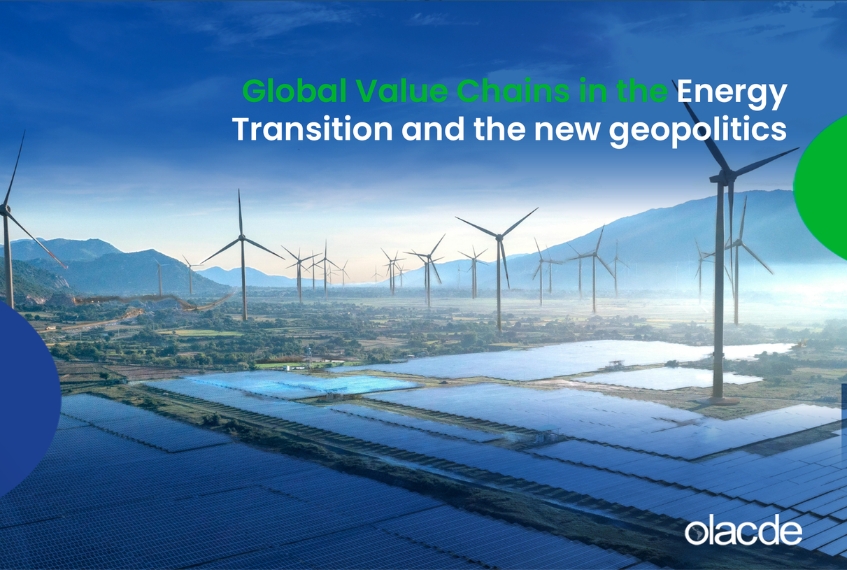
This is the central conclusion of the new working paper, “Global Value Chains in the Energy Transition and the New Geopolitics,” jointly developed by the Latin American and Caribbean Energy Organization (OLACDE) and the Georgetown Americas Institute (GAI). The study argues that the energy transition is far more than a decarbonization process—it represents a structural transformation of economic, technological, and geopolitical power on a global scale.
According to the report, technologies such as solar and wind power, battery manufacturing, electric mobility, smart grids, and clean hydrogen are fundamentally reshaping global production networks. As these industries evolve, an increasing share of economic value is being captured through knowledge, innovation, advanced manufacturing, and technology development.
Strategic resources, uncertain development
Latin America and the Caribbean hold a privileged position within this emerging energy landscape. The region possesses significant reserves of lithium, copper, and other critical minerals, while also boasting some of the world’s greatest renewable energy potential. Nevertheless, the report cautions that these comparative advantages do not automatically translate into higher levels of economic development.
The study highlights a longstanding paradox: countries rich in natural resources often capture only a limited share of the economic value generated because they remain concentrated in the early stages of production. By contrast, the highest-value activities are typically found in research and development, technological innovation, and advanced manufacturing.
Geopolitics is reshaping global supply chains
The report argues that international competitiveness is no longer determined solely by production costs. Economic security, supply chain resilience, strategic autonomy, and diversification have become decisive factors influencing global investment and manufacturing decisions.
Emerging trends such as nearshoring and friend-shoring illustrate how production networks are increasingly being reorganized according to geopolitical and institutional considerations, rather than purely economic ones.
For OLACDE, this evolving landscape presents a significant opportunity for Latin America and the Caribbean—provided the region develops the industrial and technological capabilities needed to move into higher value-added segments of global supply chains.
A Public Policy Agenda to Capture Greater Value
To seize this opportunity, the report proposes a comprehensive strategy aimed at strengthening regional competitiveness through long-term public policies. Its key recommendations include:
- Developing national strategies for effective integration into global value chains.
- Aligning industrial, trade, and energy policies.
- Expanding investment in logistics, energy, and digital infrastructure.
- Strengthening specialized human capital and STEM education.
- Promoting innovation ecosystems focused on applied research.
- Advancing regional integration to increase production scale and competitiveness.
- Establishing stable regulatory frameworks that attract long-term investment.
- Moving beyond raw mineral extraction toward processing, manufacturing, and industrialization of critical minerals.
The report concludes that the energy transition represents the most significant economic opportunity for Latin America and the Caribbean in decades, while also posing one of the region’s most complex strategic development challenges. According to the study, the region must act now to transform its natural resource endowment into robust industrial capabilities capable of supporting a new model of sustainable economic growth.
The decisions made today will determine whether Latin America and the Caribbean emerge as strategic players in the global energy economy—or remain primarily exporters of raw materials.
Full report: https://www.olade.org/publicaciones/cadenas_valor_esp/