

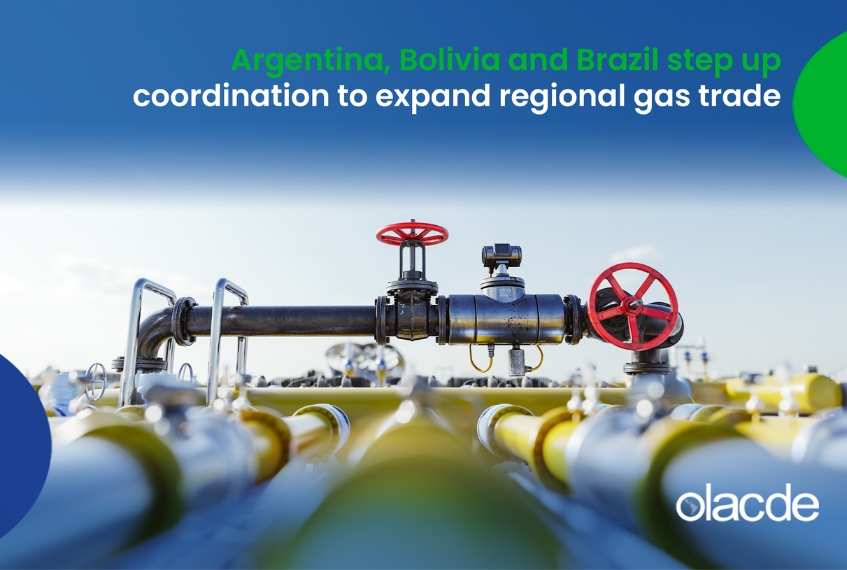
The Latin American and Caribbean Energy Organization (OLACDE) brought together representatives from Argentina, Bolivia and Brazil to advance coordination on the conditions needed to expand natural gas trade among the three countries during the upcoming spring–summer period.
The meeting built on work launched in 2025 to facilitate the transit of Argentine gas to the Brazilian market through Bolivia. One of the main issues discussed was the differences between the transportation products available in the three countries, particularly the terms governing interruptible transportation and the costs these asymmetries can generate across the value chain. Participants also addressed tariffs and contracting conditions, the coordination of operational schedules and gas quality requirements.
Participants included representatives from Argentina’s National Gas and Electricity Regulatory Authority, Transportadora de Gas del Norte (TGN); Bolivia’s Yacimientos Petrolíferos Fiscales Bolivianos (YPFB), YPFB Transporte, the Ministry of Hydrocarbons and Energy and the National Hydrocarbons Agency (ANH); as well as Brazil’s National Agency of Petroleum, Natural Gas and Biofuels (ANP), the Ministry of Mines and Energy and Transportadora Brasileira Gasoduto Bolívia-Brasil (TBG).
Producers and traders operating across different segments of the gas value chain also took part.
During the meeting, participants agreed that the upcoming spring–summer season presents an opportunity to increase regional gas flows. Argentina said scheduled maintenance is expected to have less impact on transportation capacity than in the previous year and highlighted regulatory and tariff changes introduced in 2026. Producers and traders also pointed to growing interest in Argentine gas from the Brazilian market and stressed the need to develop transportation products and conditions that reflect the interruptible nature of Argentine exports, reduce additional costs and provide greater operational flexibility.
Bolivia said it is working on alternatives to provide greater flexibility for gas transit, including a service designed to respond to potential supply disruptions from Argentina, while also reviewing its regulatory framework and tariff structure. Brazil, meanwhile, is reviewing the regulation and tariffs governing its gas transportation system amid increasing market openness and competition.
“We still have challenges to address in three major areas: technical issues, operational aspects and tariff conditions. Advancing this optimization agenda can lead to better prices, greater competitiveness, increased investment and stronger intraregional trade, while helping replace imports from outside the region and strengthening energy security,” said Guido Maiulini, Head of Strategic Advisory at OLACDE.
Coordination is particularly important given the outlook for the coming months. During the spring–summer season, priority demand for natural gas in Argentina declines, increasing the availability of exportable volumes through the country’s northern pipeline system. Forecasts of a strong El Niño could further extend that window: while it could improve hydrological conditions in the Paraná and Uruguay river basins, it could reduce hydropower availability in northern Brazil and the Amazon basin, potentially increasing demand for thermal power generation and natural gas.
The meeting is part of OLACDE’s ongoing work with MERCOSUR countries and Chile to deepen regional gas integration. Building on the challenges identified, authorities, regulators and industry stakeholders will continue coordinating efforts to gradually move beyond seasonal exchanges toward conditions that enable a more fluid, competitive and sustained regional gas market.