

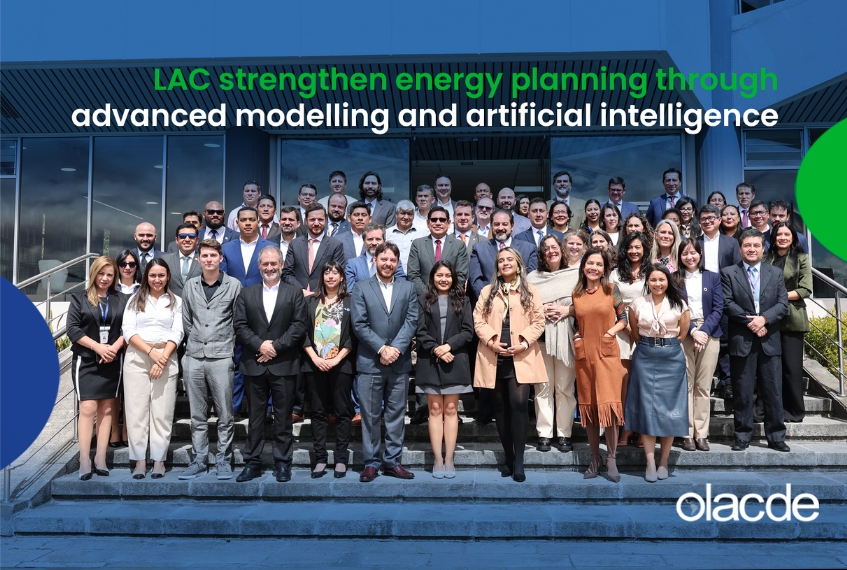
The headquarters of the Latin American and Caribbean Energy Organization (OLACDE) is hosting the Regional Training Course on Land, Energy and Climate Supply Modelling – MESSAGE from Monday, August 24, through Wednesday, August 26. The course is organized by Ecuador’s Ministry of Environment and Energy, the International Atomic Energy Agency (IAEA) and OLACDE.The 4th Meeting of OLACDE’s Regional Energy Planning Council is also taking place during these days.
The event brings together representatives and specialists from countries across Latin America and the Caribbean, along with experts from international organizations, to exchange experiences and strengthen the technical capacities needed to anticipate scenarios, assess resources and improve long-term decision-making across the region’s energy systems.
The sessions address the regional energy planning landscape and its current status, alongside national experiences and progress in energy supply studies. Delegations will present their main advances and existing gaps, contributing to a shared assessment of the challenges facing regional energy planning.
At the opening session, Javier Medina, Acting Minister of Environment and Energy of Ecuador, underscored the importance of strengthening planning as a tool for sound decision-making: “Better planning leads to better decisions. Integrating climate, water, land and energy into our analyses will enable us to build more climate-resilient planning, strengthen energy security and make long-term decisions that deliver tangible benefits for our countries.”
For his part, Facundo Deluchi, Programme Manager for Latin America at the International Atomic Energy Agency (IAEA), noted that the region has well-established technical capabilities and human resources in energy planning. “The challenge is to make better use of these capacities, strengthen regional cooperation and ensure that this knowledge has a tangible impact on public policy and on our ability to respond to the region’s energy challenges.”
Andrés Rebolledo, Executive Secretary of OLACDE, also emphasized the need to strengthen a long-term vision: “Energy planning is now a strategic priority for Latin America and the Caribbean. In a context marked by rapid technological change, climate challenges and the growing integration of renewable energy, we need a vision that transcends political cycles and helps guide the economic, social and energy development of our countries.”
One of the workshop’s main technical areas is the CLEW methodology — Climate, Land, Energy and Water — and the MESSAGE tool, which enable an integrated analysis of the interactions between energy, climate, land and water. The programme explores the relationships between the use of these resources and energy systems, as well as modelling tools designed to support public policy and long-term planning decisions.
The agenda also includes artificial intelligence applied to energy planning, as well as international cooperation and financing to strengthen these processes. The technical programme includes a session of the Regional Energy Planning Council (CRPE) and the Regional Community of Practice, focused on advancing towards a medium-term regional energy planning agenda.
Following the training sessions, activities will continue on Thursday, August 27, and Friday, August 28, with participation in the Andean Forum on Regional Energy Integration of the Andean Community, linking the course’s technical work with a broader agenda for regional energy cooperation and integration.