

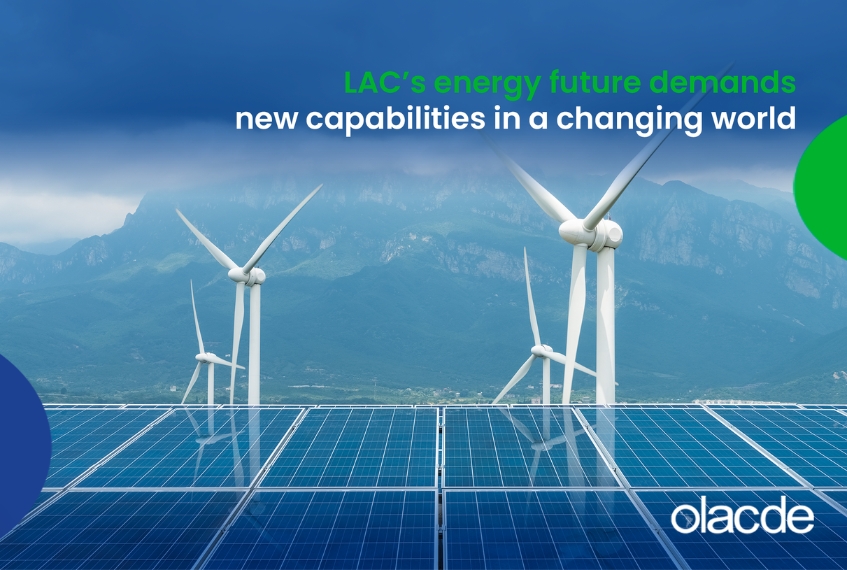
The Latin American and Caribbean Energy Organization (OLACDE) and the National University of Rosario (UNR) have launched the third cohort of the Master’s Degree in Energy Transitions, bringing together professionals from 10 countries across Latin America and the Caribbean. The region’s diversity is one of the program’s key strengths, enabling participants to examine energy transitions through different national realities while strengthening regional networks for knowledge exchange and cooperation.
During the opening session, OLACDE Executive Secretary Andrés Rebolledo highlighted the rapid pace at which the global energy landscape is changing.
Geopolitical developments, evolving markets, emerging technologies, and their impacts on Latin America and the Caribbean, he noted, require continuous updates to both knowledge and the regional debate on energy transitions. Comparing the current cohort with the first, which began approximately two years ago, Rebolledo emphasized that while there is some degree of technological continuity, the international context has changed significantly.
This evolving landscape presents a strategic challenge for Latin America and the Caribbean: developing professionals who are capable not only of understanding technological transformations, but also of anticipating their economic, regulatory, environmental, and social implications. The Master’s program seeks to bridge the gap between technical knowledge, regulation, and innovation through an interdisciplinary approach designed to strengthen decision-making capabilities in a sector undergoing continuous transformation.
Representing the National University of Rosario, Darío Maiorana, Director of the Center for Interdisciplinary Studies, emphasized that the challenge is to develop energy leaders who are both technically proficient and capable of understanding the social and strategic dimensions of energy. He underscored that access to energy is closely linked to development and that energy transitions must integrate environmental sustainability and inclusion alongside economic and political considerations.
One of the program’s core objectives is to strengthen foresight capabilities, enabling professionals to anticipate future scenarios and contribute to the decisions that will shape the region’s energy future. This preparation is particularly relevant given the rapid evolution of areas such as renewable energy, energy efficiency, sustainable energy system planning, geopolitics, electric mobility, and energy storage.
The third cohort began its academic activities on August 7, 2026. With this new edition, OLACDE and the National University of Rosario are further strengthening a partnership that places knowledge, regional cooperation, and specialized training at the heart of efforts to equip Latin America and the Caribbean to respond to an increasingly complex and rapidly evolving global energy landscape.