

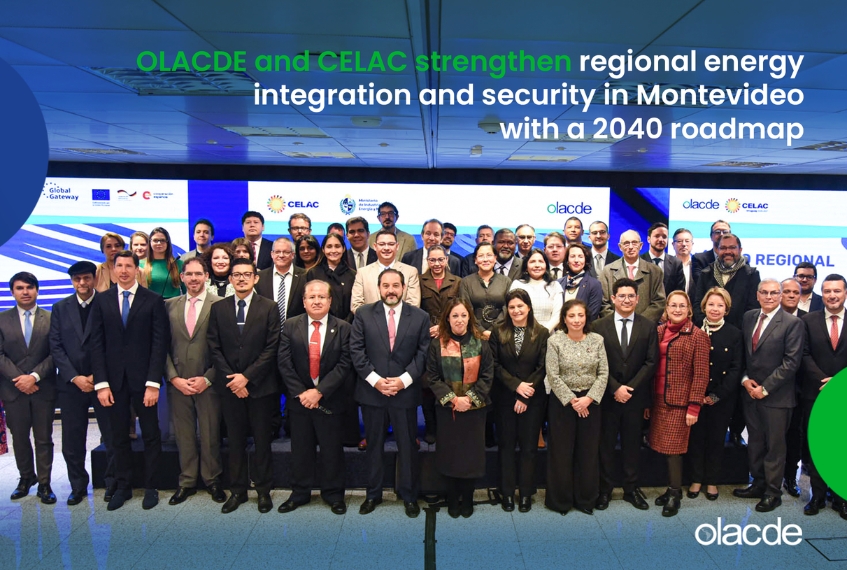
The Latin American and Caribbean Energy Organization (OLACDE) and the Community of Latin American and Caribbean States (CELAC) presented on Wednesday, June 17, in Montevideo, the Regional Indicative Plan for Electricity Interconnection with a 2040 horizon. The initiative—promoted jointly with the European Union through the Euroclima programme and implemented by GIZ—sets out a long-term vision defining the key electricity corridors for the region’s energy future.
The programme, made up of 16 electricity interconnection infrastructure projects, requires an initial investment of US$3.5 billion by 2040, a figure that technical reports describe as highly profitable, with an estimated payback period of between two and six years. The target for 2040 is to achieve an optimal interconnection capacity of 5,000 MW, significantly reducing CO₂ emissions and expenditure on fossil fuels.
The investment plan presents an average benefit-cost ratio of 10 to 1, with a net economic benefit ranging between US$1 billion and US$5 billion annually, the latter under a high-electrification scenario across the region. These benefits would be realized through the secure and affordable exchange of clean energy between neighbouring countries.
The VIII CELAC Ministerial Meeting on Energy took place on Thursday, June 18, with the participation of financial institutions and cooperation partners, with the central objective of discussing the challenges of regulatory convergence in the energy sector amid a context marked by climate variability and the expansion of renewable energy.
OLACDE Executive Secretary Andrés Rebolledo stressed the importance of launching a process aimed at dialogue and negotiation towards an Energy Integration Treaty for Latin America and the Caribbean, a legal instrument that currently does not exist in the region and whose creation is now more urgent and necessary than ever to strengthen energy security, regional cooperation, and the sustainable transition.
The ministerial gathering served as a strategic platform to lay the foundations for a political dialogue process. The ultimate goal of member states is to move towards the construction of a future energy integration treaty for Latin America and the Caribbean, a binding framework that will consolidate resource exchange, harmonize regulations, and guarantee the region’s energy security in the face of the challenges of the twenty-first century.