

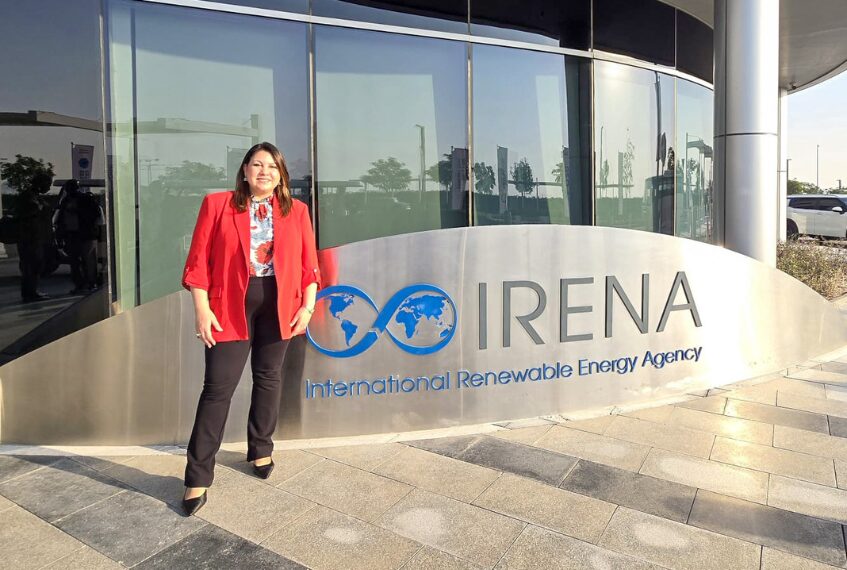
Gloria Alvarenga, Director of Integration, Access and Energy Security of the Latin American and Caribbean Energy Organization (OLACDE), participated in the 16th Assembly of the International Renewable Energy Agency (IRENA), held in Abu Dhabi. The event brought together more than 1,500 global leaders and decision-makers to define actions aligned with the UAE Consensus, the 2030 Agenda, and the Paris Agreement.
During the meeting, Alvarenga took part in the panels “Pathways for a Renewable Future across Latin America and the Caribbean: Regional Energy Transition Outlook for South America” and “High-Level Consultation towards the SDG 7 Review at the HLPF 2026: Tripling Renewables in Support of the 2030 Agenda and Beyond.” She emphasized that Latin America and the Caribbean have one of the cleanest electricity matrices in the world, yet still face structural challenges related to universal energy access, climate vulnerability, and financing constraints.
In her remarks, ensure she highlighted the need to strengthen regional energy integration to diversify sources and improve system reliability, promote energy efficiency as a key tool to reduce emissions and costs, and ensure a just and inclusive transition that places people at the center and leaves no one behind. She also stressed the importance of regional cooperation, technological innovation—including green hydrogen and energy storage—and access to financing for sustainable projects.
Within the framework of the Assembly, chaired by OLACDE member country the Dominican Republic, it was highlighted that the region reached nearly 70% renewable electricity generation in 2025, positioning it among the cleanest in the world. In this context, Alvarenga underscored the importance of strengthening political dialogue, multilateral cooperation, and consensus-building to accelerate the global energy transition.
OLACDE also contributed the regional perspective in the panels “Towards the Review of SDG 7 at the HLPF 2026” and “Building the Foundations for Gender Data in Energy: Why, How and What Next?”, where it was emphasized that without gender statistics it is not possible to design truly inclusive energy policies. In this regard, initiatives such as the Latin American and Caribbean Network of Women in Energy (RedLACME), technical training programs, and actions aimed at reducing energy poverty were highlighted.
With an emphasis on regional cooperation, the use of robust data, and women’s leadership, OLACDE reaffirms its commitment to a sustainable, just, and equitable energy transition that contributes to the economic and social development of Latin America and the Caribbean.