

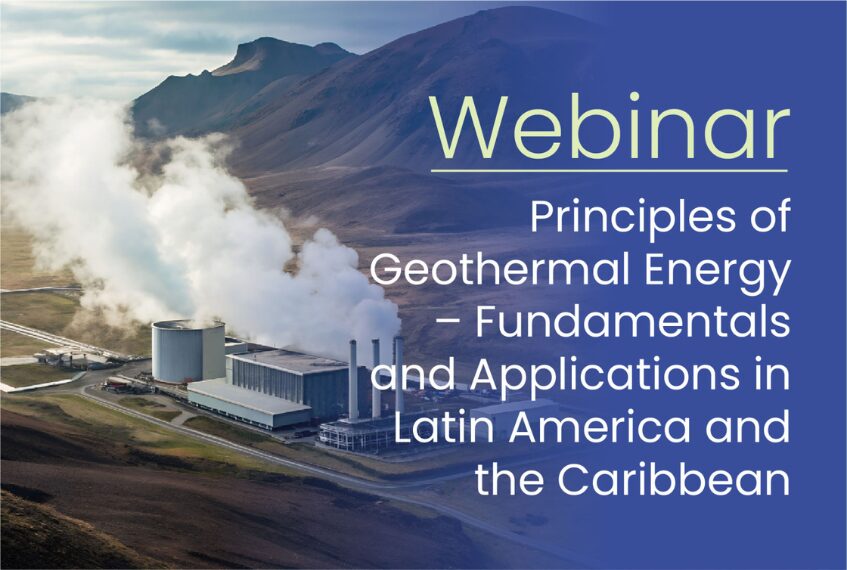
The Latin American and Caribbean Energy Organization (OLACDE) held the webinar “Principles of Geothermal Energy: Fundamentals and Applications in Latin America and the Caribbean”, a technical training aimed at strengthening regional knowledge on geothermal utilization as a key renewable source for the energy transition. The session covered essential concepts related to geothermal resources, generation technologies, direct uses, and the main challenges and opportunities for its development across the region.
OLACDE’s Executive Secretary, Andrés Rebolledo, inaugurated the event by emphasizing the importance of diversifying the regional energy matrix through clean, safe, and continuously available solutions. He highlighted that geothermal energy provides system reliability and low emissions—attributes that are fundamental for advancing a robust energy transition in Latin America and the Caribbean. Rebolledo noted that although the technology faces challenges related to high upfront costs, especially during exploration and drilling phases, countries such as Mexico, Ecuador, and the Central American subregion are advancing projects that demonstrate the significant geothermal potential of the territory, particularly due to its location along the Pacific Ring of Fire.
Gloria Alvarenga, OLACDE’s Director of Integration, Access, and Energy Security, welcomed participants and underscored that geothermal energy is one of the most renewable, stable, and reliable sources for both electricity generation and sustainable heating and cooling applications. She stressed that, in order to move effectively toward broader deployment, it is essential to build solid understanding of basic principles, associated technologies, geological conditions, and the technical, environmental, and economic challenges inherent to geothermal development.
The webinar explored several factors influencing geothermal expansion in the region. It was noted that high upfront costs remain the main barrier, as geothermal’s levelized cost of energy (around USD 60/MWh) is still higher than that of other renewable sources such as solar and wind. The session also clarified that geothermal’s seemingly low thermal efficiency—between 20% and 28%—is a result of physical limits rather than technological shortcomings, underscoring the importance of communicating this reality to avoid misconceptions. Participants highlighted that geothermal energy offers highly stable, 24/7 availability, with capacity factors above 85%, positioning it as a strategic complement to variable renewables. However, persistent gaps in geological data and unstable regulatory frameworks increase investment risks, reinforcing the need for regional studies, geothermal mapping, open data platforms, and clear regulations that encourage investment.
Finally, the webinar emphasized that despite the vast geothermal potential in Latin America and the Caribbean, its current contribution to the regional electricity matrix remains below 1%. This underscores the urgency of promoting pilot projects and fostering regional cooperation to share knowledge, technology, and best practices. The training session forms part of OLACDE’s ongoing efforts to strengthen technical capacities, promote regional collaboration, and accelerate the energy transition toward cleaner, more resilient, and sustainable systems across the region.
Watch the full webinar at the following link. https://www.youtube.com/watch?v=oZUx-L1GUgg&feature=youtu.be