

The Latin American and Caribbean Energy Organization (OLACDE) delivered the course Impact of the Incorporation of Electric Mobility on Distribution Networks, a technical training space aimed at analyzing one of the most significant changes currently facing the electricity sector in Latin America and the Caribbean: the growing adoption of electromobility and its effects on the planning, operation, and expansion of power networks, particularly at the distribution level.
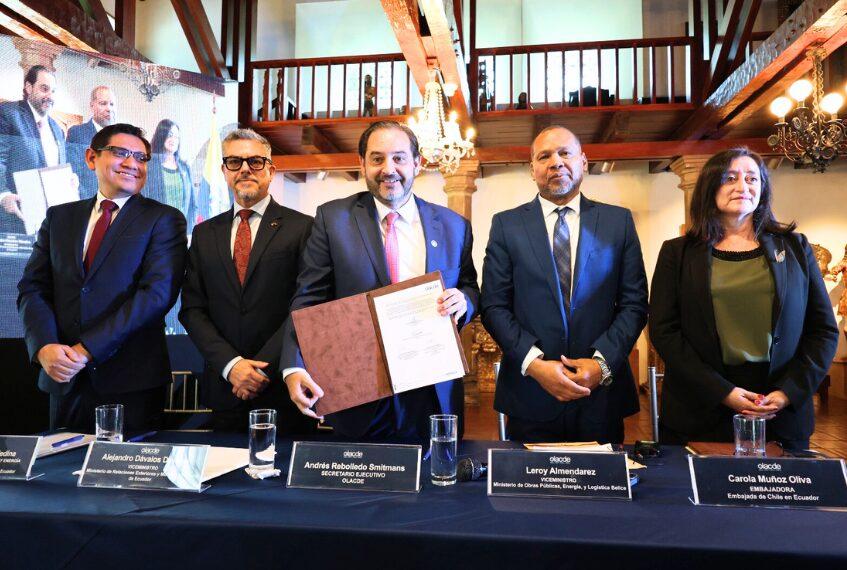
During the opening session, Andrés Rebolledo, Executive Secretary of OLACDE, highlighted the importance of strengthening regional energy integration and preparing power systems to support the transition toward cleaner, more efficient, and sustainable technologies, underscoring that electric mobility must be addressed as a structural component of energy planning.
From the academic perspective, Dennis Rivera, from the National Autonomous University of Honduras, presented studies on the impact of electromobility on power systems with structural constraints, providing modeling and assessment tools adapted to the Central American context. In his analysis, he noted that the incorporation of electric vehicles in the region requires careful planning that considers grid capacity, available infrastructure, costs, and the economic realities of each country.
For her part, Gloria Alvarenga, Director of Integration, Access, and Energy Security at OLACDE, emphasized the need to strengthen countries’ technical and institutional capacities to anticipate the effects of new electricity demand on distribution networks and ensure service reliability.
Likewise, Fitzgerald Cantero, Director of Studies, Projects, and Information at OLACDE, contextualized the rapid growth of the electric vehicle fleet in the region and its implications for generation, transmission, distribution, and charging infrastructure, highlighting the need for an integrated vision of the power system.
During the course, Jonathan Muñoz Tábora, from the National Autonomous University of Honduras, presented technical evidence showing that the expansion of electric mobility is already generating direct impacts on distribution networks. Fast charging, which may require between 40 kW and more than 80 kW per charging point, causes sharp demand variations, voltage drops, and increased stress on feeders and transformers, in addition to introducing harmonic distortion associated with power electronics.
Discussions converged on the view that electric mobility is evolving toward smart charging schemes, with time-of-use tariffs, real-time pricing, and distributed energy resource management systems (DERMS), where electric vehicles are beginning to act as sources of system flexibility, including through Vehicle-to-Grid (V2G) schemes.
Case analyses, such as that of Honduras, showed that charging during peak hours can exacerbate overload and voltage problems, while off-peak charging is more viable, confirming that electromobility planning must coordinate charger location, operating schedules, grid capacity, and tariff signals.
The course concluded with a central message: electric mobility is no longer only a change in transportation, but a new operational component of power systems that requires rigorous technical planning, network digitalization, active demand management, and appropriate regulatory frameworks to advance toward more flexible, resilient, and sustainable energy systems in Latin America and the Caribbean.