

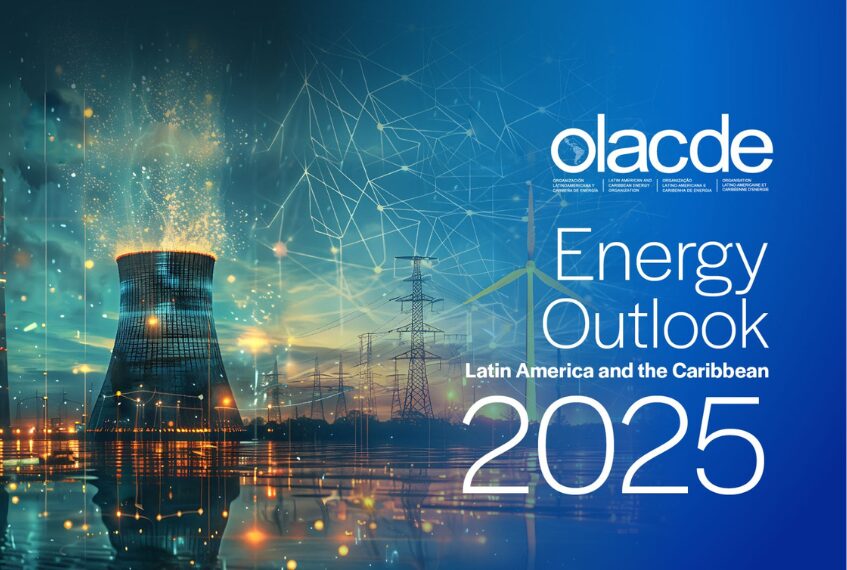
The Latin American and Caribbean Energy Organization (OLACDE) presented the Energy Outlook of Latin America and the Caribbean, its flagship annual publication that compiles the most relevant official energy statistics from its 27 Member States and analyzes the main trends, challenges, and projections of the energy transition in the region.
The report confirms that Latin America and the Caribbean (LAC) is making steady progress toward a cleaner energy matrix, in which renewable energies continue to expand, natural gas consolidates as the main firm energy source supporting this growth, and electric mobility records unprecedented expansion.
20 Key Milestones in the Energy Sector of Latin America and the Caribbean
2025 Results
1. In 2025, renewable generation capacity increased by 7% compared to 2024.
2. In 2025, 68% of newly installed capacity was renewable, and 67% of electricity generation came from clean sources.
3. Sixty-one percent of the new generation capacity installed in 2025 corresponds to wind and solar power plants.
4. Electricity generation from wind and solar energy in 2025 increased by 19% compared to 2024.
5. Final electricity consumption in 2025 was 3.7% higher than in 2024, while per capita consumption increased by 2.6%.
6. In LAC, sales of electrified light-duty vehicles continue to grow strongly, particularly over the last three years, resulting in an 851% increase in the number of these vehicles in circulation between 2022 and 2025—nearly a tenfold increase. As of October 2025, sales of light-duty vehicles in the region increased by 52% compared to 2024.
7. By 2025, LAC has 1.7 GW of battery energy storage capacity.
8. Natural gas–fired generation capacity increased by 12% compared to the previous year.
9. In 2025, electricity generation from coal decreased by 21%, while generation from oil and oil products fell by 31%.
10. Crude oil production in LAC in 2025 increased by 20% compared to the previous year; regional domestic demand rose by 24%, and net exports increased by 13%.
Projections to 2050 under an Accelerated Decarbonization Scenario (NET-ZERO)
11. Under an accelerated decarbonization scenario of the LAC energy sector (NET-ZERO) by 2050, total energy consumption would increase by 42% compared to 2025, while electricity consumption would grow by 156%, nearly tripling.
12. Under this same scenario, while the renewability index of final energy consumption stands at 31% in 2025, it would reach 48% by 2050.
13. Installed electricity generation capacity would triple by 2050 compared to 2025, and its renewable share would increase from 68% in 2025 to 83% in 2050. Combined wind and solar capacity would increase fivefold.
14. Nearly 1,000 GW of additional electricity generation capacity will be required, supported by 80 GW of battery banks, with an estimated total expansion cost of approximately USD 1.5 trillions, of which 90% would correspond to renewable capacity.
15. Electricity generation by 2050 would triple compared to 2025, and its renewability would increase from 67% in 2025 to 76% in 2050. By that year, wind and solar combined would account for 37% of total generation, while natural gas would represent 22% of total electricity generation.
16. Under the assumptions of the NET-ZERO scenario, electricity consumption in the transport sector in LAC would represent nearly 10% of the sector’s total energy consumption by 2050, 3% of total final energy consumption in the region, and 9% of total electricity consumption in the region.
17. With the expansion of data centers in LAC, electricity consumption from these facilities would represent, by 2050, 40% of the total electricity consumed by the commercial and services sector, one-third of the total energy consumption of that sector, 10% of total electricity consumption in the region, and 4% of total final energy consumption in the region.
18. Electricity requirements for green hydrogen production in LAC—both for domestic consumption and exports—considered under the NET-ZERO scenario for 2050, would amount to approximately 12% of total electricity generation in the region and 4% of total energy supply in that year.
19. Of the total energy supply in LAC by 2050, natural gas would account for 34%, compared to 26% in 2025, while the share of non-conventional renewable energy sources would increase from the current 5% to 14% by 2050.
20. By 2050, oil and oil products would represent 20% of the region’s total energy supply, while coal would account for only 1%.
The Energy Outlook of Latin America and the Caribbean thus consolidates itself as a key decision-making tool, providing solid evidence on the direction of the regional energy transition and the technical, economic, and investment challenges that will need to be addressed in the coming decades.
Download the Energy Panorama of Latin America and the Caribbean 2025: https://www.olade.org/en/publicaciones/energy-outlook-of-latin-america-and-the-caribbean-2025/
Watch video: https://www.youtube.com/watch?v=4b5aismhGHo