

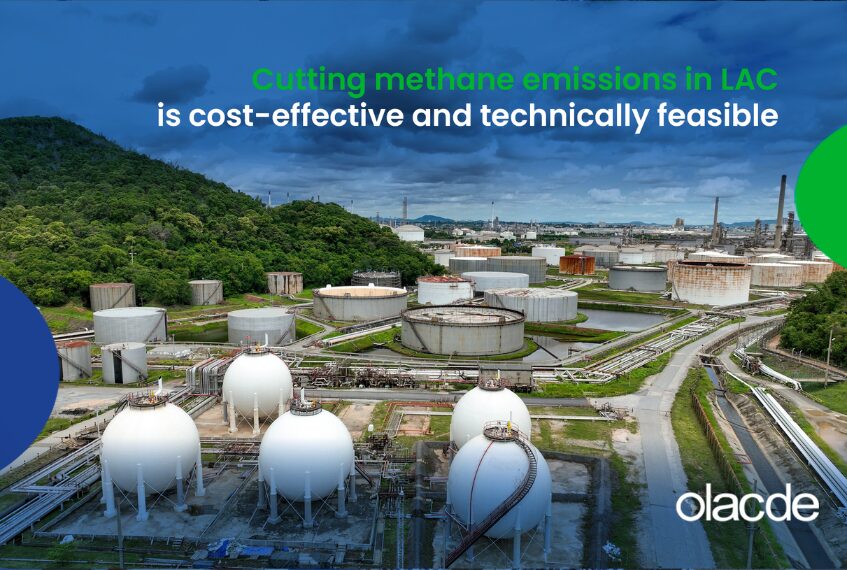
Tackling climate change in Latin America and the Caribbean can also make economic sense. A new study presented by the Clean Air Task Force (CATF) during the webinar “How Much Does It Cost to Reduce Methane? Mitigation Options and Costs in Latin America and the Caribbean,” organized by the Latin America and the Caribbean Methane Emissions Observatory (OEMLAC) of the Latin American and Caribbean Energy Organization (OLACDE), shows that the region could eliminate more than 3.6 million tonnes of methane emissions annually from the oil and gas sector by deploying technologies that, in many cases, largely pay for themselves.
The report assessed the potential impact across nine countries in the region — with a particular focus on Argentina, Brazil and Mexico — and examined four major sources of methane leakage and waste in the oil and gas industry:
- Flaring.
- Undetected leaks from infrastructure.
- Evaporation from storage tanks.
- Emissions from valves and pneumatic systems.
Affordable and Cost-Effective Solutions
The research concludes that most of these emissions reductions can be achieved at low or even negative cost, as recovered gas can be sold. Among the most effective measures are Leak Detection and Repair (LDAR) programmes using optical gas imaging (OGI) cameras, the installation of vapour recovery units on storage tanks, and the replacement or upgrading of pneumatic systems with zero-emission alternatives.
While cost-effectiveness varies from country to country depending on local gas prices, interest rates and existing regulatory frameworks, the conclusion is clear: the technology is already available.
The critical role of regulation
The study stresses that technology alone is not enough. To translate these solutions into measurable emissions reductions, governments across the region need to establish clear and predictable regulatory frameworks that require or incentivize operators to take action.
With this evidence, regulators and decision-makers across Latin America and the Caribbean have a stronger basis for prioritizing investment, designing effective public policies and turning methane emissions into opportunities for greater operational efficiency.