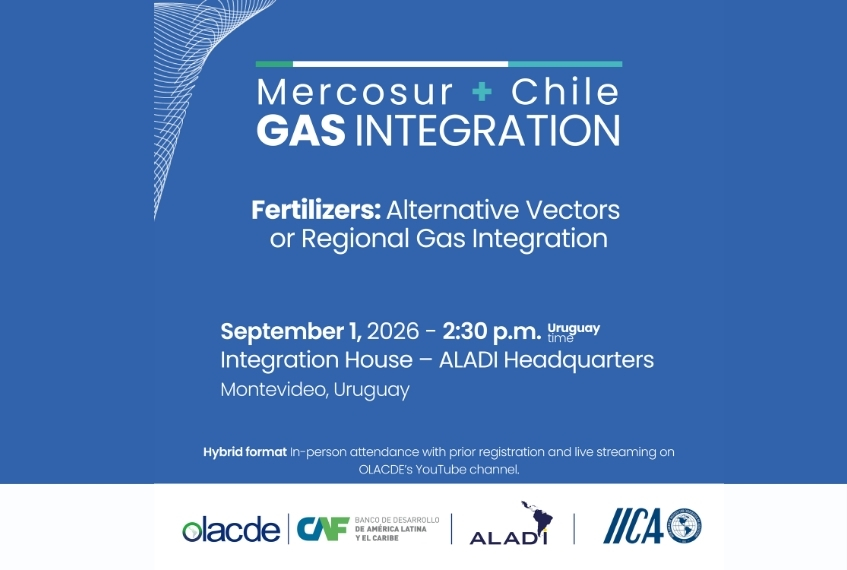


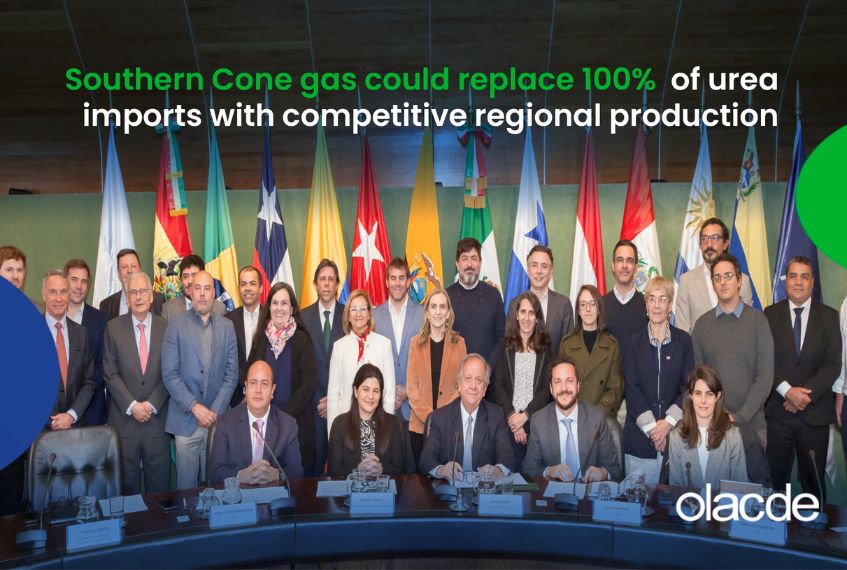
The Latin American and Caribbean Energy Organization (OLACDE) and CAF – Development Bank of Latin America and the Caribbean, with the support of the Latin American Integration Association (ALADI) and the Inter-American Institute for Cooperation on Agriculture (IICA), held the event “MERCOSUR + Chile Gas Integration: Alternative Pathways for Regional Gas Integration – Fertilizers” in Montevideo. The meeting brought together government officials, regional and international organizations, companies, and experts from the energy and agricultural sectors.
Opening the event, Guido Maiulini, Head of Strategic Advisory at OLACDE, said: “The global landscape has changed, and the region needs to respond pragmatically. Latin America has vast energy, food and human resources, as well as public- and private-sector capabilities to transform them into development. The challenge is to build collective solutions that connect energy, agriculture, infrastructure and trade, allowing us to harness these opportunities for the benefit of our countries and their citizens.”
Sergio Abreu, Secretary-General of ALADI, said: “Energy integration must be part of a medium- and long-term strategic vision that goes beyond government cycles. We need to learn how to work together across countries, productive sectors, regional organizations and financing institutions to harness the complementarity of our resources and translate it into greater productivity and competitiveness for the region.”
Arianna Spinelli, National Director of Energy at Uruguay’s Ministry of Industry, Energy and Mining, added: “The challenge is no longer simply to consider how much gas we have, how much we consume or how we can transport it, but rather what economic activities we can generate from that availability, what industries we can develop and what value we can add. This project began by asking how we could integrate our energy systems; today, we can begin asking what we can do with that integration.”
Mercedes Pedreira, Executive at CAF’s Directorate of Integration, Trade and Investment, said: “At CAF, we see integration as a concrete tool for promoting development. Initiatives such as this help build a shared vision and align resources, capabilities and markets around common objectives. That is the kind of integration we seek to support.”
Edgar Chacón Rodríguez, IICA International Representative, said: “Food security is the common denominator of this effort. For IICA, it is essential that these initiatives do not remain merely on paper, but reach the agricultural sector. Production costs ultimately pass through to consumers, and that is where we need to address the issue.”
OLACDE then presented the findings of Phase VI of the MERCOSUR and Chile Regional Gas Integration Project, which assessed alternatives for transforming the region’s growing natural gas availability into increased fertilizer production, reducing import dependence and meeting demand from the Southern Cone’s agricultural sector.
In 2025, MERCOSUR countries and Chile consumed 21.4 million tonnes of nitrogen fertilizers while producing just 1.8 million tonnes. Imports accounted for 92% of demand, at a cost of USD 6.513 billion. Dependence is particularly significant for urea, the main source of nitrogen for regional agriculture: imports amount to around 10 million tonnes annually, worth approximately USD 4 billion. Securing supplies of this input is strategic for a region that exports more than USD 250 billion a year in agricultural-based products.
Against this backdrop of high external dependence, the findings show that available gas resources could enable the region to replace 100% of its urea imports with competitively produced regional supply. Reaching that level of output would require approximately 12 million cubic metres per day of additional natural gas demand and investment of around USD 15 billion.
This outlook is underpinned by growing gas availability across the Southern Cone. Argentina’s Vaca Muerta formation and Brazil’s pre-salt resources could support a significant expansion in fertilizer production, an industry in which gas prices and availability are critical determinants of competitiveness. This resource base is complemented by existing and planned industrial capacity: the region currently has 4.5 million tonnes of installed capacity, of which only 39% was utilized in 2025, while four projects under development or consideration could add around 5 million tonnes of new annual capacity. Even if all these projects move forward, regional market demand could accommodate twice that amount of new capacity.
The study also shows that regional production could achieve competitive costs compared with extra-regional urea imports. A new plant capable of producing one million tonnes annually would require approximately 1.7 million cubic metres of natural gas per day. Under the assumptions assessed, production costs would remain below the urea import costs observed over the past five years with delivered gas prices at the plant of up to USD 14 per MMBtu.
The location of new industrial capacity is another key consideration. Natural gas can either be transported to plants located close to major consumer markets or converted into urea near producing basins, with the fertilizer then transported to end markets. The findings point to the need to diversify plant locations to prevent logistics corridors from becoming congested and to optimize the balance between proximity to gas resources and end markets.
Conditions for expanding production and supply vary across countries. In Argentina, the development of Vaca Muerta has enabled two projects that could add 3.5 million tonnes of annual urea production capacity, enough to replace the country’s current imports and generate additional volumes for other markets. Brazil, meanwhile, accounts for nearly 80% of regional consumption and represents the largest potential market for new production, while the availability of pre-salt gas and the reactivation of Petrobras plants offer opportunities to restore domestic production capacity.
Bolivia provides a concrete example of converting natural gas into fertilizers for the regional market. Since the Bulo Bulo plant began operations, the country has replaced virtually all of its urea imports and has become an exporter of between 200,000 and 500,000 tonnes annually, mainly to neighboring countries. In 2025, the plant supplied 85% of the urea consumed in Paraguay.
The potential for increased regional production also extends to smaller markets with high levels of import dependence. Uruguay, where high-yield agriculture and intensive pasture systems sustain strong demand for nitrogen, uses urea for around 60% of its apparent nitrogen fertilizer consumption. Chile relies largely on imported urea to supply its agricultural sector, while Paraguay combines regional supplies from Bolivia with a rapidly expanding market.
Replacing urea imports would allow a greater share of the Southern Cone’s gas resources to be directed toward the regional production of higher-value-added goods. Developing new production capacity could stimulate investment, create jobs, reduce logistics costs and monetize gas resources, while strengthening food security and agricultural productivity in one of the region’s most important economic sectors.
Following the presentation, the panel “Prospects for Fertilizer Production in the Region” brought together representatives from Petrobras Fertilizantes, Pampa Energía and APLA to discuss opportunities for expanding production, existing projects, natural gas availability, infrastructure, logistics and the conditions required to mobilize new investment. The session was moderated by Christian Leroux Cazaubon, Undersecretary for the Free Trade Area at ALADI.
The second panel, “Agriculture in MERCOSUR: Growth Prospects and the Role of Fertilizers,” featured representatives from IICA, CAF, Embrapa and IF Ingeniería en Fertilizantes and was moderated by Arianna Spinelli, Uruguay’s National Director of Energy. The discussion addressed growth prospects for the regional agricultural sector, trends in fertilizer demand and the role these inputs play in productivity, competitiveness and food security.
Watch the full event:
https://www.youtube.com/live/rG-XNzyRPus?si=CaPkTM16Gp6z4n2k