

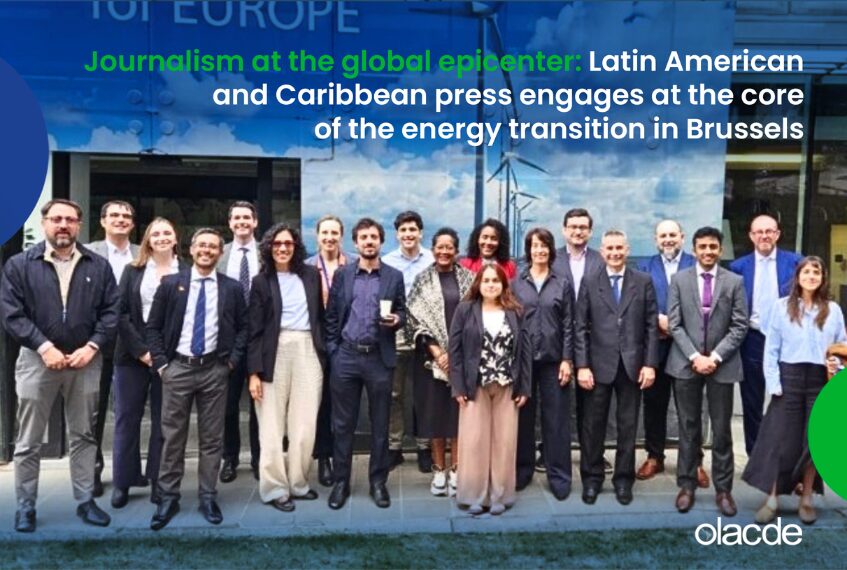
From June 7 to 12 this year, the Belgian capital became the meeting point for a strategic journalistic network shaping the future of sustainable development. Within the framework of the EU Climate Dialogues 2 (EUCDs2) Study Tour—a joint initiative led by the European Union (EU), the German Development Cooperation (GIZ) and OLACDE—a delegation of 15 journalists from Latin America and the Caribbean gathered at the heart of European policymaking to gain direct access to the institutional, technical and governance spaces where the policies guiding the planet’s decarbonization are being designed.
This collective engagement not only provided access to cutting-edge information, but also strengthened a specialized press network capable of analyzing and reporting firsthand on the trends shaping the global energy transition roadmap.
For the Latin American and Caribbean Energy Organization (OLACDE), participating in this high-level gathering in Brussels represented far more than an in-depth journalistic exercise; it marked the consolidation of a key institutional bridge. The European Union, in its role as a permanent observer of OLACDE, extended this invitation with a clear purpose: to connect Europe’s regulatory and industrial leadership with the transformative renewable potential of our region, turning bilateral relations into a true strategic alliance for a climate-neutral future.
Direct Access to the Sources of Global Change
During an intensive week of technical and political immersion, the agenda allowed the press delegation to enter the core of decision-making at the European Commission. At a defining moment for the global energy future—when rising demand calls for immediate cooperation—the study tour opened the doors to key spaces such as the European Sustainable Energy Week (EUSEW) and enabled direct dialogue with official voices, industry leaders and innovators driving the European Green Deal and the REPowerEU strategy.
The working sessions ranged from the analysis of carbon markets and regulatory frameworks for renewable hydrogen, to the review of emerging critical minerals value chains and the development of sustainable aviation fuels. This was not merely a theoretical exercise; on-the-ground technical visits provided firsthand evidence of how European infrastructure and integration systems are evolving to respond to three simultaneous challenges: security of supply, industrial competitiveness and climate urgency.
From Suppliers to Strategic Partners: The New Diplomacy of Critical Minerals
One of the clearest and most politically significant messages emerging from the working sessions in Brussels was a paradigm shift: countries in Latin America and the Caribbean are no longer viewed solely as raw material suppliers, but as indispensable partners for joint development.
Our region holds an exceptional competitive advantage: it boasts one of the cleanest electricity matrices in the world—with nearly 70% generated from renewable sources—and hosts vast reserves of critical minerals such as lithium, nickel, cobalt and rare earths, all essential for the manufacturing of clean technologies, storage systems and electric vehicles.
The European approach, embodied in investment strategies such as the Global Gateway, seeks to ensure that recent announcements of strategic projects in the region translate into the creation of local value chains, technology transfer, innovation and quality job creation within supplier countries.
Under this new perspective, concepts once confined to technical debates—such as strategic autonomy and supply chain resilience—have moved to the center of international economic policy.
OLACDE and Regional Integration at the Decision-Making Table
As the organization responsible for coordinating and promoting energy integration across its 27 member countries, OLACDE’s participation in this Study Tour reaffirms the importance of keeping the region fully connected to the world’s main decision-making centers.
The energy transition can no longer be defined solely by the technical capacity to generate clean gigawatts; it requires shared visions, harmonized regulatory frameworks and strong international alliances. Strengthening political and technical dialogue between Latin America, the Caribbean and the European Union—aligned with the goals of the Paris Agreement—is the fundamental path toward building shared solutions that guarantee a just, secure, sustainable and inclusive energy transition.
Learning firsthand how global climate policy is shaped in Brussels leaves us with a clear conclusion: the future of energy is being written collectively, and our region is a leading actor at that design table.