

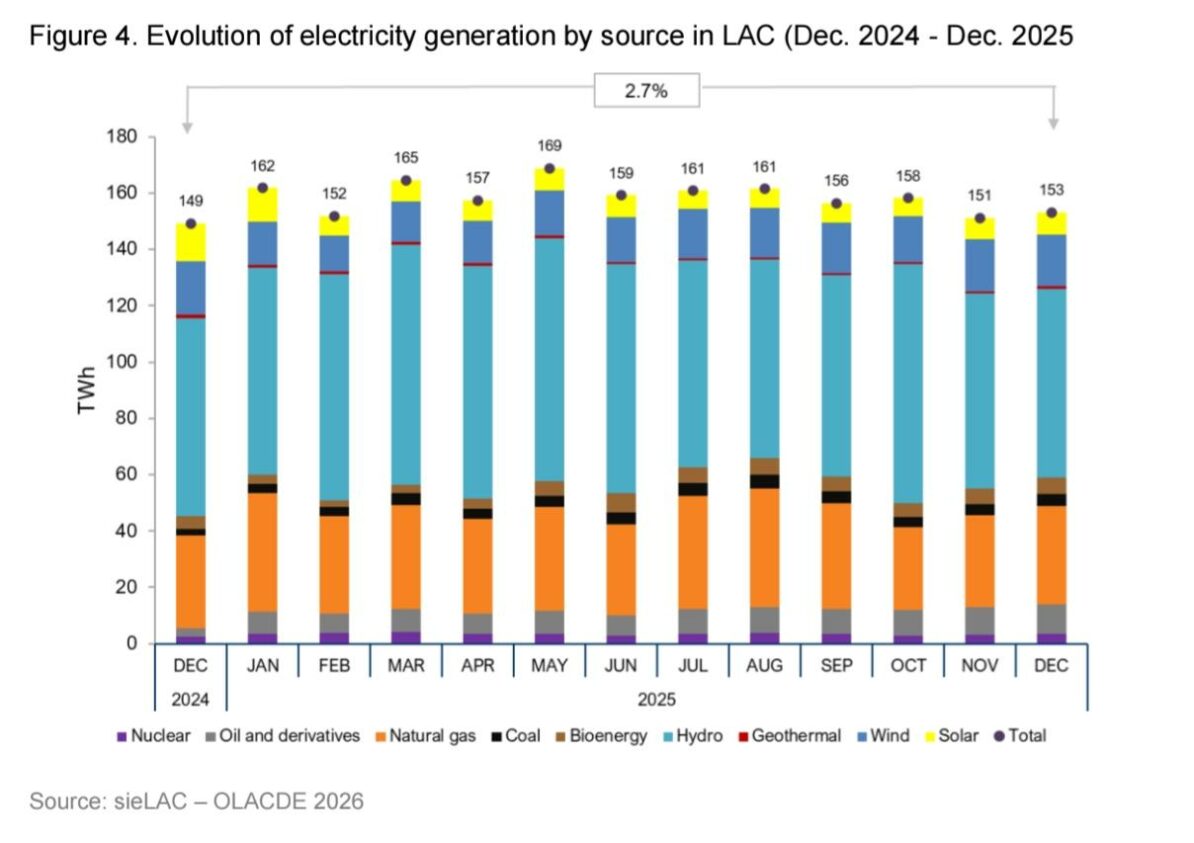
Latin America and the Caribbean (LAC) reaffirms its position as a global benchmark in sustainability, closing December 2025 with electricity generation of 153 TWh. To put this figure into perspective, this volume of energy is equivalent to the monthly demand of approximately 50 million average households across the region, underscoring the scale of LAC’s power system.
Key Technical Highlights:
• Sustained growth of the power system: Regional generation reached 153 TWh in December 2025, marking a 2.7% year-on-year increase and consolidating a trend of moderate expansion in electricity consumption.
• Increased use of thermal generation for backup: Amid a monthly decline in hydropower (3%) and wind (1%), thermal sources increased: coal (9%), natural gas (7%), and oil (5%), highlighting their role in ensuring supply security.
• Predominantly renewable matrix, but under operational pressure: The regional renewability index stood at 65%, confirming the leadership of clean energy, albeit with fluctuations linked to hydrological and climatic availability.
• Shift in year-on-year generation dynamics: An increase in fossil-based generation is observed, led by oil and derivatives (7.4 TWh), along with gas and coal, while renewable sources such as solar (−5.7 TWh) and hydropower (−3.1 TWh) declined, reflecting a temporary higher reliance on thermal sources.
• Non-traditional renewable sources: Growth of 11% in nuclear generation and 10% in geothermal energy over the past month highlights opportunities in stable energy sources that are not dependent on climatic conditions.
The Value of Energy Security:
In the current context of climate variability and international uncertainty, the region has prioritized energy security: the ability to ensure uninterrupted and affordable electricity supply under any circumstances.
Although the matrix is predominantly renewable, LAC relies on a complementary share of thermal energy (primarily natural gas), which acts as a safety net.
The breakdown by renewable sources is as follows:
• Hydropower: Accounts for 43.9%, serving as the structural backbone of the region.
• Wind Energy: Contributes 12.1%, continuing its expansion driven by declining technology costs.
• Solar Energy: Reached 5.1%, boosted by public decarbonization policies.
• Other sources: Bioenergy (3.8%) and geothermal (0.5%) provide stability in resource-specific areas.
Read full report: https://www.olade.org/en/publicaciones/april-2026-report-no-12-electricity-generation-in-latin-america-and-the-caribbean/
For more information, please contact:
Diana Soriano, Head of Communications
diana.soriano@olacde.org