

Within the framework of the First CELAC–Africa High-Level Forum, the Heads of State and Government of the Community of Latin American and Caribbean States (CELAC) and Africa met in Bogotá, under Colombia’s Pro Tempore Presidency of CELAC and Burundi’s Presidency of the African Union (AU), with the participation of specialists from both regions invited by the Co-Chairs, in accordance with international law and the Charter of the United Nations.
The Forum fostered a dialogue aimed at strengthening ties between Latin America and the Caribbean and Africa, based on mutual respect, the sovereign equality of States, solidarity, shared benefit, and the recognition of the historical and cultural ties that unite both regions.
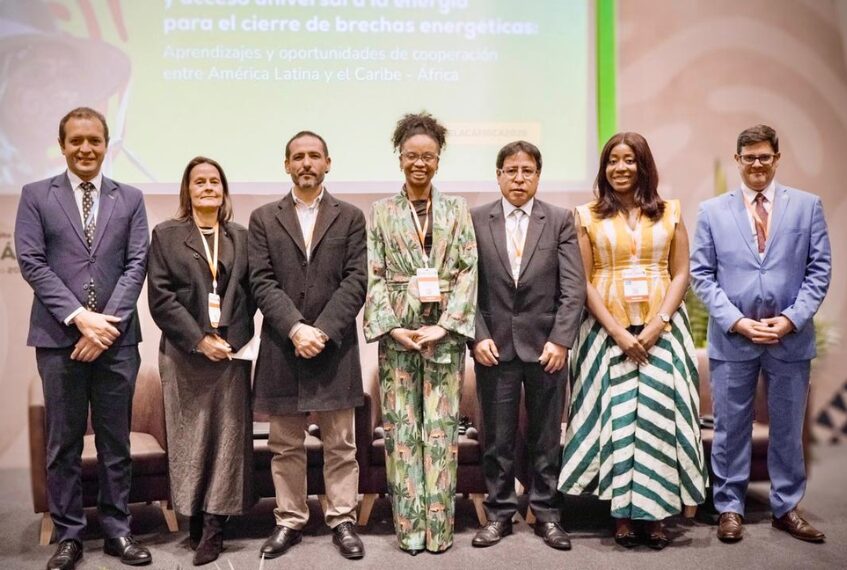
Representing the Latin American and Caribbean Energy Organization (OLACDE), Fitzgerald Cantero, Director of Studies, Projects and Information, participated as a panelist in the session “Just energy transition and universal access to energy to overcome energy poverty: lessons learned and opportunities for CELAC–Africa bi-regional cooperation.”
During his intervention, he highlighted that one of the most urgent challenges for Latin America and the Caribbean is to advance toward clean cooking, a regional target set for 2035, considering that around 70 million people still rely on firewood for cooking and heating every day. In this context, he emphasized the importance of replacing inefficient technologies with cleaner solutions such as biogas, LPG, natural gas, or distributed generation, depending on the conditions of each territory.
He also stressed the strategic role of distributed generation both to accelerate the transition to cleaner technologies and to reduce the remaining percentage of households without access to electricity in the region.
Finally, Cantero highlighted the enormous potential for cooperation between Latin America, the Caribbean and Africa in renewable energy and in the implementation of solutions to overcome energy poverty, noting that the exchange of experiences, technologies and public policies between both regions will be key to advancing toward more inclusive, sustainable and resilient energy systems.