

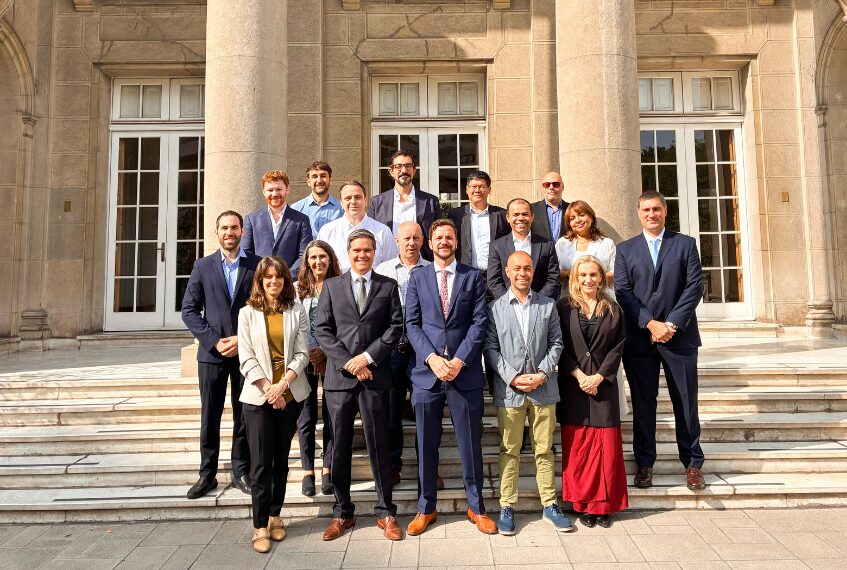
OLACDE and CAF held in Santiago, Chile the closing workshop of Phase IV of the Regional Gas Integration Project, conducted at the Faculty of Engineering of the University of Chile with the participation of authorities, national delegations, and technical teams from the Mercosur countries and Chile.
The meeting focused on the presentation and analysis of the new regional gas transport model developed by OLACDE based on information provided by the countries. The tool aims to optimize the use of existing infrastructure, identify more efficient routes, and project cost reductions under different operational scenarios.
The opening remarks were delivered by Guido Maiulini, Head of Strategic Advisory at OLACDE; Luis Felipe Ramos, Chile’s Undersecretary of Energy; and Mercedes Pedreira, Executive at CAF’s Directorate of Integration, Trade and Investment. All highlighted the importance of this stage for deepening regional cooperation and promoting a more efficient and complementary gas system.
Guido Maiulini stated: “Since we began this process in 2023, we have achieved very significant progress, and the strength of this work reflects both the commitment of the MERCOSUR countries and Chile to resume discussions on gas integration strategies, as well as the thorough work of their agencies and the essential involvement of multilateral organizations such as MERCOSUR and CAF.”
He added: “During this time, we have managed to build an alliance with clear programming foundations and created joint technical workspaces that allow us to develop the tools needed to advance regional energy integration something clearly demonstrated in today’s meeting dedicated to analyzing a new regional gas transport model.”
For his part, Luis Felipe Ramos noted: “For the Government of Chile, energy and gas integration is essential because it contributes to security, resilience, and the achievement of our environmental goals. At the Ministry of Energy, we are advancing concrete actions such as updating regulations and actively participating in this process to ensure that integration becomes an effective pillar of the country’s energy transition and decarbonization objectives.”
Meanwhile, Mercedes Pedreira emphasized: “At CAF, we appreciate the time and dedication that each delegation has invested in this study, which aligns with our commitment to regional integration and a just energy transition. The partnership with OLACDE that gave rise to this work is a fundamental tool for addressing the challenges our countries face today.”
During the workshop, the delegations advanced in validating the hypotheses and data provided by the countries, reviewed the topology of the regional transport system, and analyzed operational and planning constraints identified at the national level. Real-time simulations were also carried out to assess how the model behaves under variations in transport, production, and demand costs, as well as to observe the effects on flow allocation and the economic efficiency of the system.
Within this framework, results emerged highlighting the need to expand evacuation capacity from Neuquén; reinforce intermediate infrastructure to meet the potential demand of Paraguay and northern Uruguay; and adjust the model to reflect expected changes in Brazil’s transport system over the coming years.
The model open-source and under continuous refinement makes it possible to identify more competitive transport routes, minimize costs, and estimate indicators of interest for the countries, such as the final gas price at each node, over short- and medium-term horizons, under different configurations and scenarios considered plausible by the region.
Through this work, OLACDE and CAF consolidate a key tool for optimizing gas transport costs and strengthen joint planning to advance regional energy integration.